From First Build to Full Scale


What was the challenge?
Our customer is an innovation-driven subsidiary founded within one of the world’s most respected automotive OEMs — purpose-built to accelerate the future of mobility. A software-focused organization at its core, their mission centers on autonomous driving: pairing advanced AI decision-making with a parent company’s deep expertise in safety, quality, and scale.
To sharpen that technology, they needed data. Lots of it. And to gather it, they needed a fleet of highly instrumented test vehicles: production SUVs stripped down and rebuilt with a sophisticated autonomous package of cameras, LIDAR, sensors, and the compute systems to tie it all together. A driver pilots each vehicle. The sensor suite captures real-world data. That data feeds the algorithms pushing their autonomous ambitions forward.
Building those vehicles — and building them right — was the challenge. And it’s exactly the kind of challenge Roush loves.
The Challenge
Turning cutting-edge software into road-ready hardware is hard. For a software company, it was harder still.
They knew autonomy. What they didn’t know was manufacturing — the work instructions, the supply chain intricacies, the assembly workflows, the disciplined production process that turns a concept into a repeatable build. They needed a partner who could bring that expertise and teach as they built.
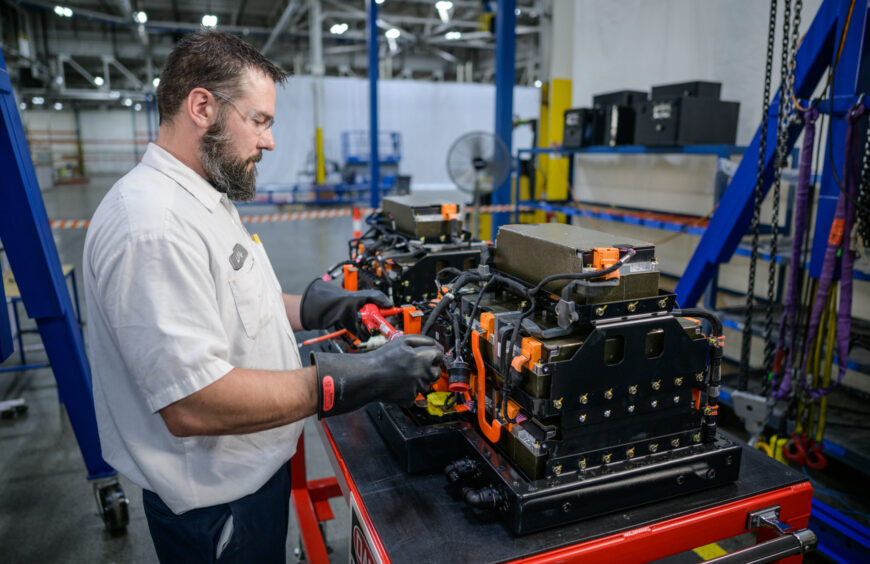
The technical demands were steep. Each vehicle required extensive modification: removing the windshield, exterior body panels, and most of the interior, then fabricating existing and installing new components to make room for the AV package. Every build needed custom wiring harnesses — bespoke assemblies engineered to exact specifications. In an autonomous test platform, a single wiring fault doesn’t just slow a build. It can compromise the integrity of the data the entire program depends on.
Then there was the uncertainty. As is common with ground-breaking programs, initial design data naturally continued to evolve, which meant a flood of engineering changes once production started. Material issues surfaced across their supply base. Volumes shifted. Timelines moved. They needed a partner who wouldn’t just tolerate that flux but absorb it — keeping the line moving no matter what came next.
And crucially, they needed one partner across the whole journey. When prototype and manufacturing functions get split across different vendors, hard-won knowledge falls through the cracks. The thread had to hold from the first prototype through fleet-scale production.
What did we accomplish?
Roush brought the full weight of its integrated capabilities to the program — not as a menu of separate services, but as one connected team carrying momentum forward at every step.
Engineering expertise where the customer needed it most
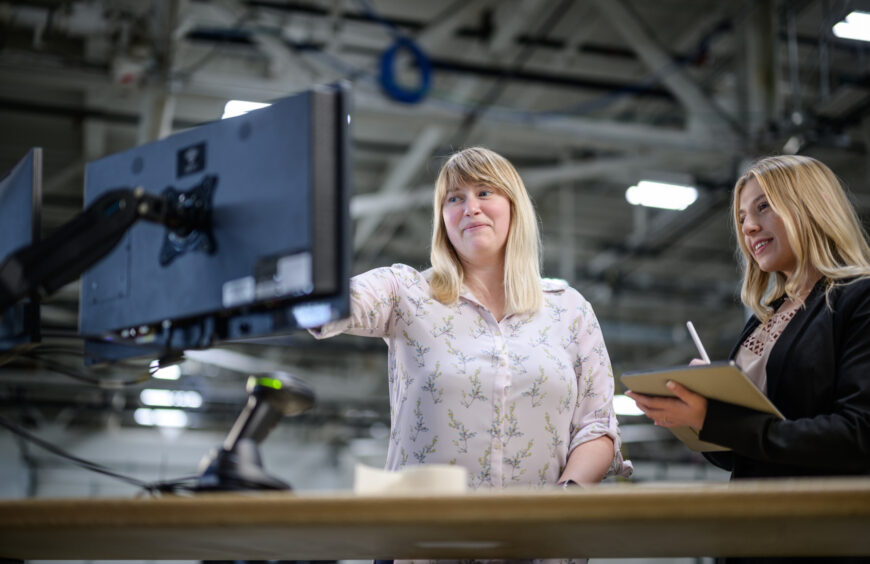
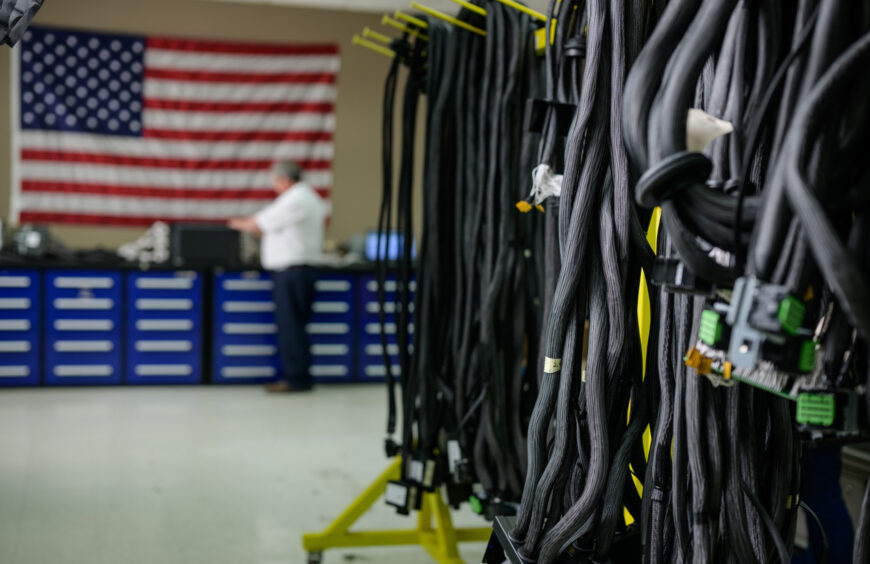
Because the customer is a software company, they often started with bare-bones schematics rather than finished wiring drawings. Roush filled that gap. Working with in-house engineers, the team took rough schematics and produced complete wire prints, first articles, and finished harnesses — a level of design support most manufacturing shops simply can’t offer.
The speed was remarkable. A typical electrical harness design runs 6 to 10 months of engineering time. Roush turned it around in about two months, from initial schematics to first articles ready to go. The customer took notice.
Wiring harnesses built in-house
Roush built the harnesses within the same walls where builds were happening — and that proximity paid off daily. When a pin backed out in transit, the fix happened in 20 or 30 minutes, not the week or two a typical ship-out-for-rework cycle demands. The customer could walk over and see the work whenever they wanted. The feedback loop stayed tight. Trust stayed high.
That in-house wiring lab also cut logistics risk. While the customer juggled a web of suppliers — some overseas, tangled in tariffs, customs, and shipping delays — Roush harnesses were hand-carried straight to the line. Even through heavy engineering changes early on, the line stayed supplied.
Roush also leaned on a smart production move: white wire, kept in-house, could be printed before parts even arrived. That head start streamlined the whole build.
Technicians on the ground
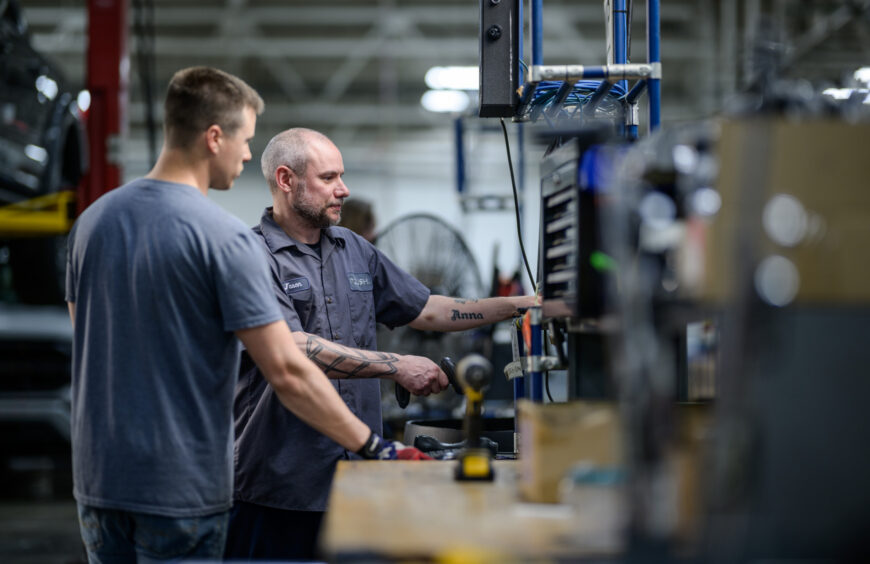
Roush deployed technicians directly to the customer’s facility — not just to observe, but to roll up their sleeves and assist with harness assembly, material movement, and sorting. The team also built trunk assembly frames on-site and later sent a dedicated material control specialist to help bridge the supply chain between the customer and Roush’s production line. Then the team brought that hands-on knowledge home and applied it to production. This is the quiet power of a skilled technician — the value isn’t only in what they build, but in what they learn and carry forward.
A deep bench of autonomous experience
Roush didn’t arrive as a newcomer. The team has been building autonomous prototypes since 2013, working with more than 28 autonomy manufacturers arriving with a hardware set, a software set, or both — and needing help integrating it all into a real vehicle. That experience, spanning contract manufacturing, one-off prototypes, and everything between, is exactly the connective tissue this program required.
Growing with the program
As the scope evolved, Roush evolved with it. What began as a vehicle build expanded to include wiring harnesses, sub-assembly of the computing system, and the roof pod sub-assembly. Each addition reflected a simple truth: the more the customer saw, the more they trusted Roush to take on.
What services were provided?
Throughout this program, Roush drew on a broad set of integrated capabilities to serve as a true full-lifecycle partner.
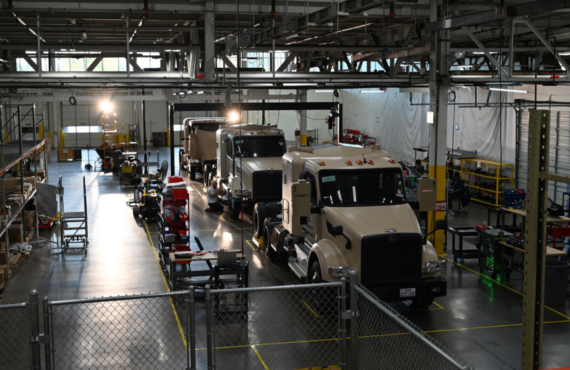
Contract Manufacturing led the core vehicle build, transforming production SUVs into fully outfitted autonomous data collection platforms. The in-house Wiring team provided end-to-end harness support — from design and engineering through first articles and production-volume builds. Prototype technicians were deployed on-site at the customer’s facility to support early ramp activities, including harness assembly, material movement, and supply coordination. Sub-assembly support expanded over time to include the computing system, roof pod, and trunk assembly — all brought in-house and integrated into the production line.
Together, these capabilities didn’t operate as separate services. They operated as one program, with shared knowledge and shared accountability at every stage.
What is the impact?
The proof shows up in the numbers — and in the relationship.
A build delivered ahead of schedule.
The program delivered around 100 vehicles — a refined scope that reflected the customer’s evolving needs as they brought select builds in-house. Rather than slow things down, the team used every adjustment as an opportunity to accelerate. The result? A production line completed a full week ahead of schedule, driven by a team that never stopped pushing for better.
Cycle time that kept improving.
Planned at seven days per vehicle, the team drove the average down to roughly five to five-and-a-half days across the latter batch — a clear sign of a workflow getting smarter with every build.
Engineering speed that impressed.
Delivering a harness turnaround up to 5x faster than the industry norm. By compressing a typical 6-to-10-month timeline into just two months, we gave our partner a massive head start on their program timeline.
Flexibility as a differentiator.
Volumes shifted. Start dates moved. The program paused, then restarted earlier than planned. Through all of it, Roush flexed on timing and resources to meet expectations — the kind of steadiness that turns a vendor into a trusted partner.
Knowledge that traveled.
Lessons from the prototype phase reshaped the manufacturing approach, from stricter kitting to a smooth, seamless flow from receiving through final quality control.
Trust that reached the top.
The strongest proof came from the people. The customer’s project management team expressed their satisfaction again and again throughout the program. A senior leader who had initially come in with reservations about the relationship left as a genuine advocate. And in a rare gesture of recognition, executive leadership from the parent organization personally acknowledged the Roush team at a major company event — a meaningful signal in a culture where trust is built from the ground up, one success at a time.
This partnership shows what becomes possible when one team stays with a program from first build to full scale. Wiring, prototype support, sub-assembly, and manufacturing didn’t live in separate silos — they lived under one roof, connected by a single knowledge base and a shared drive to solve every problem together.
For the customer, that continuity meant fewer handoff risks, faster fixes, preserved expertise, and a manufacturing process built on real prototype experience. For Roush, it’s a story that captures a core belief: the best partnerships aren’t defined by a single capability, but by the willingness to grow with a program, challenge by challenge, breakthrough by breakthrough.
They’re building the future of autonomy. We’re proud to help bring it to the road.
More Stories

Ready to move your program from first build to full scale? Whether you’re sketching early prototypes or scaling toward full production, Roush has the capabilities — and the commitment — to carry your vision forward.
Connect with our team to get started.